Project Objectives | Meet our team! | Past Talks
Project Description
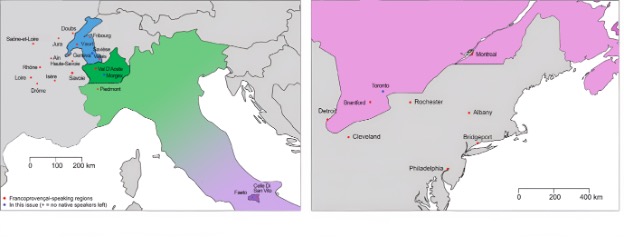
Francoprovençal (FP) communities in Canada, France, Italy, Switzerland and USA are shifting to their national language (English, French or Italian). This both endangers the language and provides a rare context to study contact-related variation in a language undergoing multiple trajectories. Our interdisciplinary research addresses the urgent need to document and analyze this minoritized language through a detailed study of clitic (weak pronoun) variability, an understudied phenomenon at the intersection of bilingualism, contact-induced change, and formal linguistic theory. Partial pro-drop languages (where clitics can only be dropped in certain contexts) like FP are poorly understood, limiting our ability to explain the breadth of cross-linguistic variation.
Project Objectives
- determine what kinds of variation exist in the expression of clitics across 6 FP varieties;
- investigate how intra-speaker variation in highly multilingual contexts relates to inter-variety differences;
- assess which aspects of syntactic, pragmatic, phonological and sociolinguistic analyses of subject clitics best account for the range of variation;
- evaluate FP data with respect to claims that minoritized languages exhibit less orderly heterogeneity than larger languages; and
- explore related applications for automatic speech recognition, speech-language pathology, pedagogy, outreach and revitalization.
We interconnect the challenges of building a robust empirical record for an endangered language and advancing frameworks capable of explaining variation, predicting change, and informing revitalization initiatives.
Read more for Project Description
This is the first systematic, theoretical, comparative description of clitics across FP varieties. Bringing together scholars Naomi Nagy, Jonathan Kasstan, Maria Polinsky and Luisa Seguin with years of experience with different varieties, we unify methods and linguistic analysis to create a coherent database for syntacticians, phonologists, sociolinguists and language practitioners. Our findings contribute to theoretical debates by modeling predictive features of the data to refine our understanding of how pronoun systems behave in multilingual and contact settings.
Our initiatives ensure that research outcomes support community engagement, clinical training, and language revitalization by linking theoretical findings to real-world practice and sustaining transmission of the language.
Meet our team!
Co-PIs

Naomi Nagy
Professor, University of Toronto
Link to Naomi’s homepage
ORCID: 0000-0002-2895-2447
Google Scholar
Discover Research
Jonathan Kasstan
Associate Professor, University of Westminster
Link to Jonathan’s homepage
ORCID: 0000-0003-4134-5876
Google Scholar
Maria Polinsky
Professor Emerita, University of Maryland
Link to Maria’s homepage
ORCID: 0000-0003-1460-5089
Google Scholar
Luisa Seguin
Post-doc, Université Côte d’Azur
Link to Luisa’s homepage
ORCID: 0000-0002-2383-8135
Google Scholar
Research assistants


Partners
Centre d’études francoprovençales (Saint-Nicolas)
More coming soon
Latest News
Kasstan, J., N. Nagy, M. Polinsky, L. Seguin, R. Szabo, J. Torangeau & G. Warriner. 2026. Francoprovençal in Motion: Migration, Contact, and Minority Communities. NWAV 54, Université de Montréal, 22-24 Oct. 2026. [poster]
Stay Tuned!